




9 Key Concepts of TFT-LCD
 Jun 13, 2023|
 Understanding some basic concepts and functions of TFT-LCD is related to display quality and device settings. In fact, in the communication and development of liquid crystal display modules, display manufacturers will provide LCD specifications as a basis for further discussion.
There are 9 key concepts for TFT-LCD:
1. Screen Size
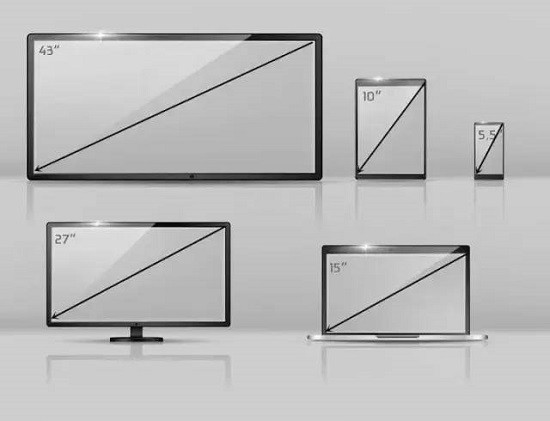
The screen size of a display refers to the diagonal length of the actual visible area, measured in inches (1 inch = 2.54 cm).
2. Aspect Ratio
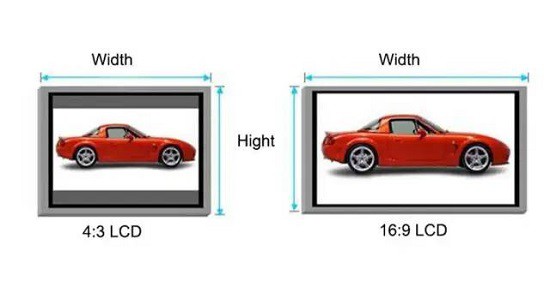
The aspect ratio of an LCD refers to the relationship and proportion between the width and height of the visible area. It is also known as the screen ratio.
The most common aspect ratios for LCD panels are 4:3, 5:4, 16:10, and 16:9, with 16:9 being best suited to human vision and closest to the golden ratio.
H (horizontal) and V (vertical) are typically used in the design of TFT LCD modules to denote length and breadth.
3. Active Area (AA)
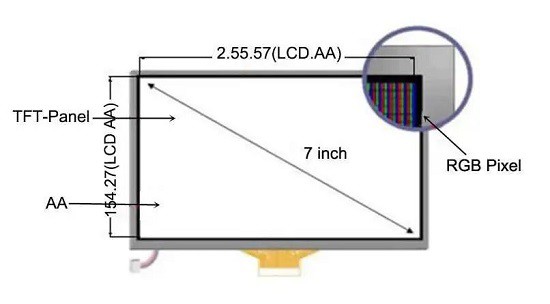
The active area is the total area of the TFT-LCD that can display images. However, factories usually only mark the length and width of the area on the drawing for easier understanding. By using the diagonal length and aspect ratio of the LCD screen, the specific length and width of the active display area can be calculated using the Pythagorean theorem.
4. Pixel
A pixel is one of the small dots that make up a display screen and is used as a unit of resolution.
 |
5. Pixel Pitch The pixel density of a display, or the quantity of pixels per inch in size, is known as PPI. Displays with higher PPI values provide clearer images. (X, Y, Z) represent the number of pixels in length, width, and screen size. |
 |
6. Pitch Pitch refers to the distance between pixels and adjacent pixels. The design value of the Pitch is calculated based on the active area. Pitch (horizontal) = Active area horizontal size/horizontal resolution Pitch (vertical) = Active area vertical size/vertical resolution Note: Generally, when we talk about Pitch, we refer to the pixel spacing in the horizontal direction. |
7. Resolution
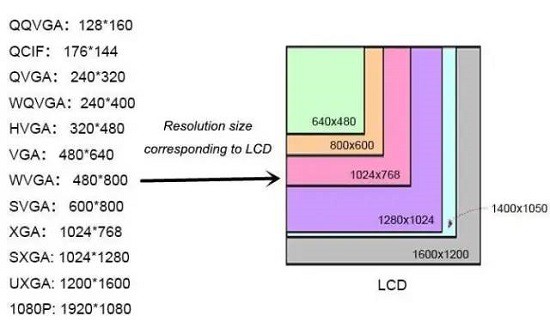
The size of the dots that make up the image determines the resolution, which is a measurement of the image that is presented.
The quantity of horizontal and vertical pixels is typically expressed as "horizontal pixels x vertical pixels".
When a display has a resolution of 1024 x 768 pixels, for instance, the active display area has 1024 pixels in the horizontal direction and 768 pixels in the vertical direction.
8. Power Consumption
Since approximately 90% of the power consumption of TFT-LCD comes from the backlight, adjusting the power consumption of the LCD module needs to start with the backlight. Theoretically, a large-sized LCD uses more power than a small-sized LCD to produce the same brightness.
9. Lifespan
How long can an LCD screen be used? The lifespan of an LCD module mainly depends on its illumination (LED light bar in the backlight). When the performance of the light source drops sharply, the display becomes useless. The industry uses hours to evaluate the lifespan of LCDs.
LCD and TFT-LCD screens can be used normally for tens of thousands of hours. In other words, an LCD can last more than 10 years if utilized for 5 hours per day.