




TFT LCD Show and Its Benefits in the Electronics Industry
 Aug 10, 2023|
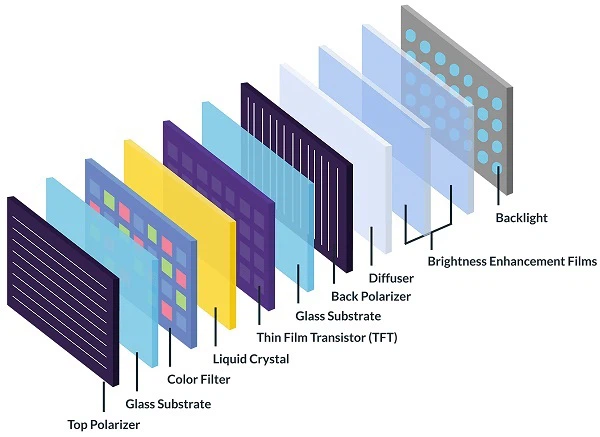
 The structure of a TFT LCD display primarily consists of three components: the back panel module, liquid crystal layer, and front panel module.
Back Panel Module:
The back panel module refers to the portion behind the liquid crystal layer and is composed of components such as the rear polarizer, back glass substrate, pixel unit (pixel electrode, TFT transistor), and PI alignment film. The back glass substrate is covered with numerous transparent metal film conductors arranged in a grid pattern both horizontally and vertically, insulating each other. This divides the back glass substrate into small grids known as pixel units (or sub-pixels). Within each grid (pixel unit), there is a transparent metal film electrode insulated from the surrounding conductors, known as the pixel electrode (display electrode). At one corner of the pixel electrode, a TFT thin-film transistor is fabricated on the glass substrate using printing techniques. It is connected to both vertical and horizontal conductors, forming a matrix structure. The gate electrode of the TFT transistor is connected to the horizontal line, known as the gate scan line or X electrode. This line serves the purpose of TFT selection and is also called the select line. The source electrode of the TFT transistor is connected to the vertical line, known as the source column line or Y electrode. The drain electrode of the TFT is integrated with the transparent pixel electrode. The function of the TFT transistor is that of a switch; applying a gate voltage to the TFT switch controls its conduction and cutoff.
Liquid Crystal Layer:
The back glass substrate of the TFT LCD display contains pixel electrodes and thin-film transistors (TFT), while the front glass substrate is equipped with a color filter. The liquid crystal layer is sandwiched between the front and back glass layers. TFT is a layer of indium tin oxide (ITO) on the glass surface. When TFT is controlled by an electrical signal, it generates transparent thin-film transistors that control the current passing through the liquid crystal, thereby regulating the transparency of each pixel.

TFT-LCD stands out due to its perfect integration of semiconductor technology, liquid crystal material technology, and active emission technology. In the field of liquid crystal displays, the transition time of liquid crystal molecules' elongation and rotation is only a matter of milliseconds. Driven by semiconductor technology, the TFT-LCD industry has grown and advanced, consistently triumphing over other display technologies in competition.
Furthermore, the TFT-LCD industry possesses the following advantages:
Strong Color Reproduction: TFT-LCD can achieve a color gamut of up to 120%, providing better color reproduction compared to OLED.
Large Industry Scale: China's TFT-LCD production capacity maintains its global leadership, with a clear advantage in industry infrastructure.
Wide Application Scope: it holds the largest market share in fields such as mobile phones, computers, and televisions.
All in all, the upsides of the TFT LCD display industry and market request guarantee its situation as a standard showcase innovation for a significant period into what's in store.
If you have any questions on LCD displays, you can contact us at sales@innoluxlcdpanel.com