




Using TFT Touch Screen - Best Practices
 May 23, 2023|
 The TFT touch screen is becoming increasingly popular in various devices from consumer electronics to industrial and medical equipment. While the design concept of using TFT LCD touch screens is already mature, engineering and product design teams often encounter difficult-to-solve problems. Following the best practices for using TFT LCD touch screens can reduce many troublesome situations.
Best Practices for Installing TFT LCD Touch Screen:
Ensure that there is sufficient space between the product casing and the TFT LCD screen.
When installing the TFT LCD module, ensure that it does not twist, deform, or bend.
◆Installation of CTP with Borders
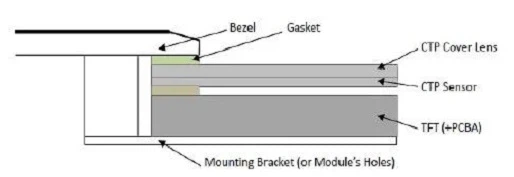
The window of the border should be larger than the active area of the capacitive touchpad (>0.5mm).
An insulating gasket (0.5~1mm) should be installed between the border and the CTP surface.
For ultra-thin TFT LCD displays, it is recommended to add a back support bracket.
◆CTP Surface Installation
Double-sided adhesive is used to attach the TFT LCD display's settlement region.
It is recommended to leave a gap (>0.3mm) between the production casing and the LCD cover glass.
When needed (e.g., when the TFT touch screen has no stacking structure), back support with a gasket should be used.
If additional cover glass is required, the engineer should recheck the CTP specifications, and understand acceptable materials and thicknesses.
There should be a gap of 0.2~0.3mm between the cover glass and the TFT LCD surface.
The window of the cover glass should be larger than the active area of the TFT touch screen (>0.5mm).
◆RTP Installation
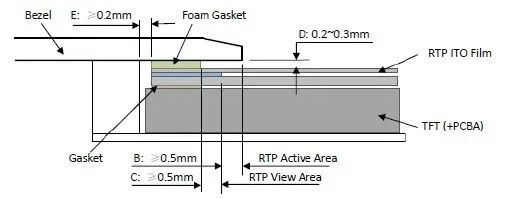
There should be a gap of 0.2~0.3mm between the border and the TFT LCD touch screen surface.
The border should cover at least 0.5mm (B) of the visible area of the TFT LCD screen to prevent users from pressing the RTP ITO film connection area.
There should be a gap of 0.2~0.3mm between the border side and the TFT LCD side wall.
Best Practices for Grounding Design
If the grounding method of a device equipped with a touch screen does not follow best practices, various problems can occur. Common challenges related to grounding include:
Poor noise resistance, interference will have a negative impact on device operation.
Long-term drift, that is, as time passes, the voltage changes will reduce the performance of the display.
Generally speaking, there are two key considerations: keeping the grounding connection as short as possible, and keeping impedance to a minimum. This requirement is particularly critical in the grounding connection between the display casing and the touch controller. The diameter of the grounding connection also has an impact, but its length does not have as much effect.
Another important consideration in grounding design is to avoid grounding loops. A star-shaped topology grounding distribution can avoid a potential difference between the two points that need to be grounded.
Any floating conductive parts near the touch sensor will cause unstable touch function. Therefore, they should have the same grounding potential as the touch controller.